Quit bad habits
Quitting isn't one decision. It's a few hundred small ones.
Almost nobody quits because they finally found enough willpower on a Tuesday. They quit because the next craving got handled — and then the one after that, until handling it stopped being remarkable.
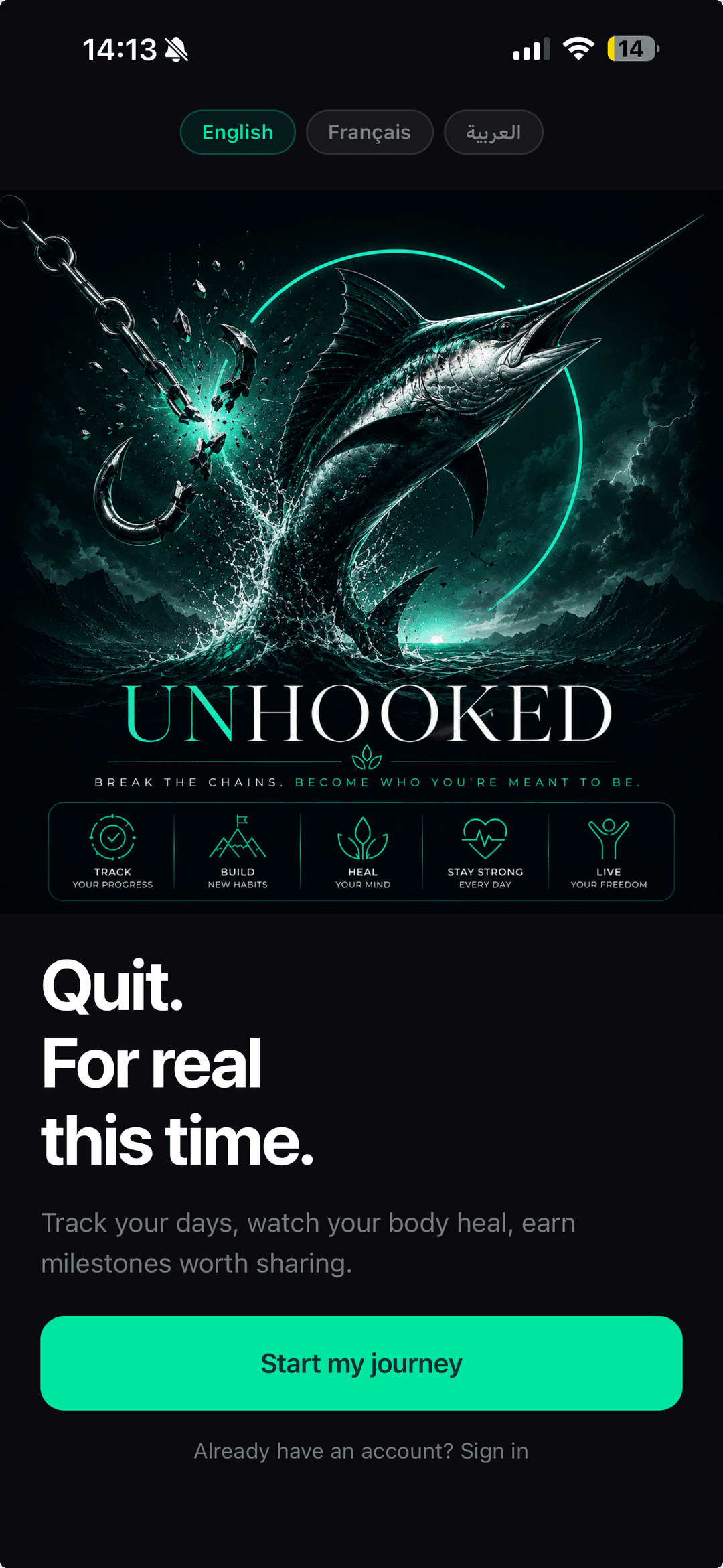
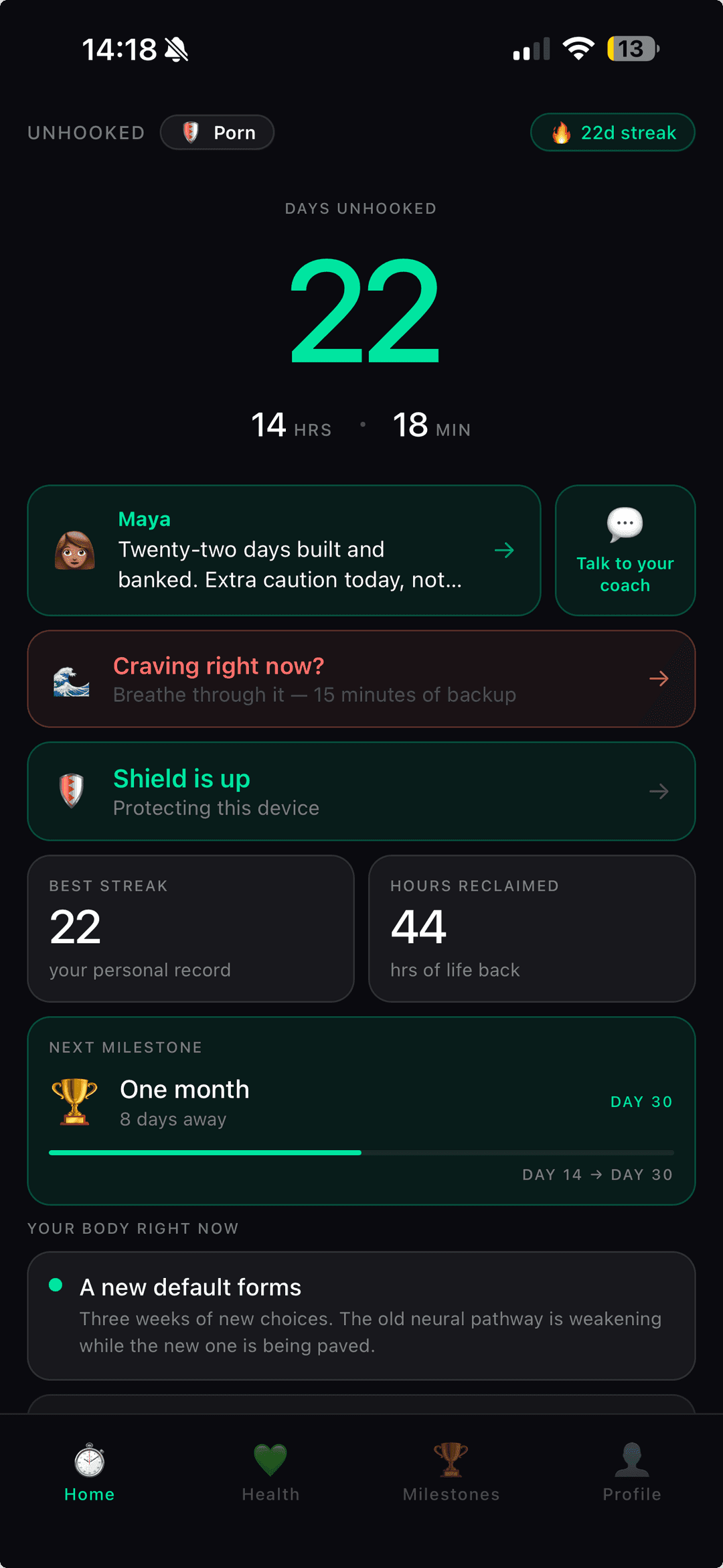
Unhooked is a bad habit quitting app for porn, smoking and alcohol. It gives you a 15-minute urge timer for the moment a craving lands, an AI coach to talk it through, website blocking that puts friction in the way, and day-by-day tracking of your streak, your money saved and your progress.
The real problem
Willpower is a bad plan because it runs out.
Willpower isn't a character trait you either have or lack — it behaves much more like a resource that depletes. It is lowest exactly when you need it most: late at night, after a hard day, when you're tired, alone, bored or upset.
That's not a coincidence. Habits attach themselves to those moments precisely because that's when you're least able to argue back. Which means any plan that consists entirely of "try harder next time" is a plan that fails on the nights that actually matter.
The alternative isn't to become someone with more willpower. It's to need less of it: decide in advance, make the easy path slower, and have something concrete to do in the fifteen minutes when the urge is loudest.
What actually works
How fast you restart matters more than whether you slip.
The people who succeed at quitting are usually not the ones who never slipped. They're the ones who got back to it quickly — the same day, or the next — instead of treating one bad night as proof that the whole attempt was fake.
A slip that turns into a week is a very different event from a slip that turns into a fresh start the next morning. The gap between those two outcomes is mostly about what you believe the slip means.
This is why Unhooked keeps your total days, your best streak and every comeback, not just the current number. A reset takes the counter back to zero. It doesn't take you back to zero.
The method
Six things that make quitting stick.
None of these are clever. They're just the things that keep showing up in people who actually get free of something — and each one has a matching tool in the app.
- 1
Write down the honest reason
Not the reason you'd give out loud — the real one. You'll need it on a night when it stops feeling obvious, and a sentence you wrote in a clear moment argues better than you can mid-craving.
- 2
Start the counter today
Not Monday, not the first of the month. A visible number that grows is one of the few things that reliably makes progress feel real, and day one is only ever available right now.
- 3
Change the environment first
Set up blocking while it's easy and costs you nothing. The version of you in the middle of an urge should not get a vote on how reachable the habit is.
- 4
Have a plan for the first fifteen minutes
An urge is loudest at the start. Knowing exactly what you'll do in those minutes — a timer, a walk, a message — beats trying to white-knuckle an unstructured hour.
- 5
Have someone to talk to at 2am
Cravings don't keep office hours. Being able to say what's happening, out loud, to something that answers takes a surprising amount of pressure out of the moment.
- 6
Treat a slip as information
Log it, look at what led up to it, and start again. A slip tells you which situation you're not yet ready for. That's useful. Shame isn't.
In the app
The tools that run the method.
15-minute Urge Timer
One tap when a craving hits: a countdown, a breathing circle, your reason, and everything you'd be giving up — on one screen.
An AI coach
Message Maya or Sam whenever it's hard. No appointment, no waiting for the next meeting, no judgment about the hour.
Website Shield
Put friction between you and the habit. Turning it off means waiting — long enough for the urge to lose interest.
Streaks and comebacks
Current streak, personal best, total days free and every restart in between. The whole history, not just the current run.
Money and time back
Enter what the habit used to cost you and watch it add up, alongside the hours it used to take.
Milestones worth sharing
Day 1, day 7, day 30, a year. Each one earned, announced, and turned into a card you can share if you want to.
Questions people ask before they start
How long does it take to break a habit?
There's no honest single number. Research on habit formation has found it varies enormously between people and behaviours — often considerably longer than the "21 days" that gets repeated online. A more useful framing: the first week is about getting through cravings, and the months after are about the new default becoming boring.
What counts as a bad habit?
Anything you keep doing after you've decided you'd rather not. Unhooked currently has purpose-built modules for porn, smoking and alcohol, each with its own tracking, content and craving tools.
I've tried and failed before. Why would this be different?
Previous attempts aren't evidence that you can't — most people who quit something for good did it after several attempts. What tends to change the outcome is having a plan for the craving itself, rather than relying on resolve.
Should I quit everything at once?
Usually not. Picking one habit and giving it your full attention tends to work better than splitting your effort. You can switch modules in the app later.
Is Unhooked free?
You get full access for your first day, with no card and nothing to cancel. After that, choosing a plan starts a separate 3-day free trial — cancel before it ends and you won't be charged.
Pick your battle
Your quit date starts the day you decide.
Download Unhooked and get full access free for your first day. No payment details, nothing to cancel.